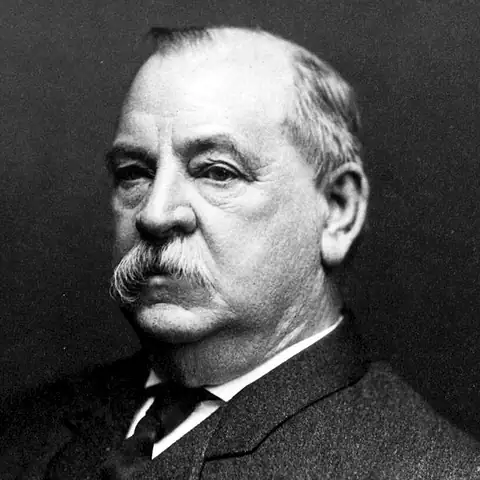
Who was Grover Cleveland?
Grover Cleveland practised law in Buffalo and won a name for honesty as sheriff, then mayor, then governor of New York. In 1884 he won the White House, the first Democrat to do so since the Civil War. Benjamin Harrison beat him in the 1888 electoral count even though Cleveland took more votes nationwide. He beat Harrison in 1892, so he is the only president with two terms that did not follow each other. The Panic of 1893 and a long depression marked his second term, along with the Pullman strike and a party fight over silver. That fight led Democrats to choose William Jennings Bryan in 1896.
Political views
- Fought the 1888 and 1892 campaigns on lowering tariffs and attacked the Republican policy of protection.Source: millercenter.org
- In 1887 he vetoed a bill to buy seed grain for Texas farmers hit by drought. He said such aid would erode self-reliance and private charity.Source: millercenter.org
- Held the Sherman Silver Purchase Act responsible for the depression and got it repealed. To rebuild the gold reserve he then issued bonds.Source: millercenter.org
- Sent soldiers to deal with the Pullman strike in 1894, although the Illinois governor did not want them.Source: millercenter.org
- Signed the 1887 Dawes Act, which split reservation land into individual plots.Source: millercenter.org
- Rejected the annexation of Hawaii once he decided that Americans had plotted to remove its government.Source: millercenter.org
- Insisted that Britain accept arbitration in its boundary quarrel with Venezuela, and sent warships to the region.Source: millercenter.org
Legacy
Admirers praise Cleveland for honesty, for standing up to his own party and to lobbyists, and for using the veto more than any president before him against pension and special-interest bills. Fiscal conservatives hold him up as a model of small government. Critics say his firm loyalty to gold and his refusal to offer relief made the depression of the 1890s worse. Labor historians condemn the troops and court orders he used to crush the Pullman strike. His backing of the Dawes Act helped strip Native Americans of most of their remaining land in later decades. Historians also point out that he did little against segregation and the loss of Black voting rights in the South.
In their own words
“Though the people support the Government the Government should not support the people.”