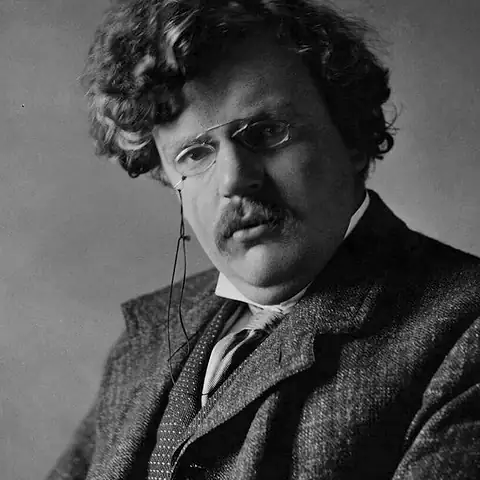
Who was G. K. Chesterton?
G. K. Chesterton was born in Kensington, London, in 1874. After art school at the Slade he turned to journalism and became one of the busiest writers of his age. His best-known work includes the Father Brown mysteries, the Christian defence Orthodoxy (1908), and two odd fantasies, The Napoleon of Notting Hill and The Man Who Was Thursday. He joined the Roman Catholic Church in 1922 after years as an Anglican. Together with his friend Belloc he shaped distributist ideas, and in 1926 he helped launch the Distributist League and ran its paper, G.K.'s Weekly. Politically he stood outside both capitalism and socialism, and he liked local, small-scale life.
Political views
- Taught that land, shops and workshops should belong to as many families as possible, an idea he named distributism.Source: christianhistoryinstitute.org
- Attacked capitalism for gathering wealth in a few private hands, and communism for gathering it in the state.Source: christianhistoryinstitute.org
- Argued that ordinary families had been kept from owning land by the ruling class, a theme of What's Wrong with the World.Source: gutenberg.org
- Called himself the last liberal and backed the Liberal Party until he broke with it in 1928.Source: en.wikipedia.org
- Wrote a book against eugenics, Eugenics and Other Evils, and opposed the 1913 law on the mentally deficient.Source: en.wikipedia.org
- Described tradition as a kind of democracy, because it gives past generations a vote.Source: gutenberg.org
- Stood up for family life and Christian moral teaching against what he saw as modern doubt.Source: gutenberg.org
Legacy
Chesterton shaped later writers. C. S. Lewis said The Everlasting Man helped lead him to faith, Jorge Luis Borges admired him, and a 1909 column of his left a mark on Gandhi. Catholic social thinkers, localists and some conservatives still draw on distributism, and Christians from both left and right respect him. Critics say distributism could never work for a whole nation, and the Distributist League, which peaked at roughly 2,000 members in 1928, fell apart in the 1940s. Scholars have also shown that his writing about Jews relied on antisemitic stereotypes. Some defenders place this in the habits of his time, but it remains a serious stain on his record.
In their own words
“Tradition means giving votes to the most obscure of all classes, our ancestors. It is the democracy of the dead.”
“The Christian ideal has not been tried and found wanting. It has been found difficult; and left untried.”