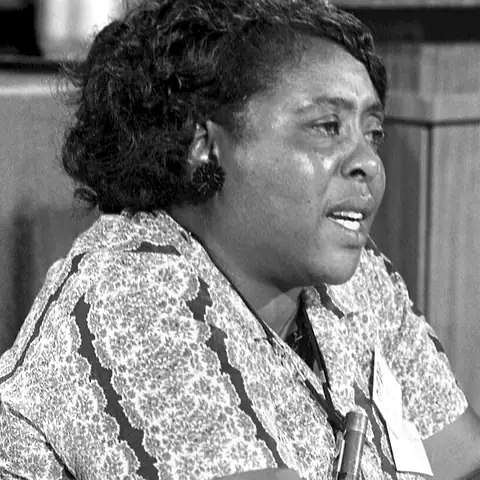
Who was Fannie Lou Hamer?
Fannie Lou Hamer was born in 1917 to sharecroppers in Mississippi, the youngest of twenty children, and began picking cotton at six. In 1962 she tried to register to vote in Indianola and lost her home and job. She joined SNCC and in June 1963 was beaten in a Winona jail. She co-founded the Mississippi Freedom Democratic Party and in 1964 told the Democratic National Convention credentials committee what Black Mississippians faced. In 1969 she started the Freedom Farm Cooperative. She ran for Congress in 1964 and died of breast cancer on 14 March 1977.
Political views
- Tried to register to vote in 1962 in Indianola, failed a literacy test and was then ordered off the plantation where she worked.Source: pbs.org
- Was beaten in a Winona, Mississippi, jail in June 1963 after a lunch-counter sit-in, with injuries to her eyes, legs and kidneys that lasted the rest of her life.Source: womenshistory.org
- Helped found the Mississippi Freedom Democratic Party in 1964 and rejected an offer of two at-large seats at the Democratic convention, saying the party wanted full seating.Source: kinginstitute.stanford.edu
- Ran for Congress in 1964, and in 1965 was lead plaintiff in a lawsuit seeking to suspend elections in Sunflower County until Black residents could register fairly.Source: womenshistory.org
- Testified before a Senate subcommittee on hunger in the Delta in 1967, launched a pig bank in 1968 and in 1969 bought land for the Freedom Farm Cooperative, which grew from 40 to nearly 700 acres.Source: womenshistory.org
- Supported school desegregation, cooperatives and Head Start.Source: pbs.org
- Helped establish the National Women's Political Caucus in 1971 and spoke publicly about the 1961 forced sterilization she suffered.Source: womenshistory.org
- Her faith motivated her activism, and she memorized many Bible verses.Source: kinginstitute.stanford.edu
Legacy
Hamer is remembered as a voice for Black Mississippians who paid a heavy price for the vote. Her televised 1964 testimony brought the violence of the Jim Crow South into American homes and helped shift public opinion. Admirers credit her with linking voting rights to food, land and dignity through Freedom Farm. Her record also shows limits. The officers who beat her in Winona were acquitted in federal court, the Freedom Democratic Party did not win a seat in 1964, she lost her 1964 race for Congress and the pig bank closed for lack of funding. She was seated as a delegate in Chicago in 1968.