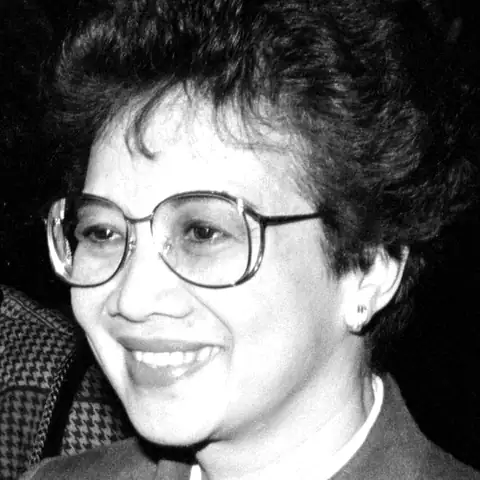
Who was Corazon Aquino?
Corazon Aquino graduated from Mount Saint Vincent in 1953 and later studied law at Far Eastern University in Manila. She stayed out of politics until her husband, Senator Benigno Aquino Jr., was assassinated in 1983. She then became a leading voice of the opposition and helped lead the peaceful 1986 revolution that ended twenty years of dictatorship. She served as President of the Philippines from 1986 to 1992, the first woman to hold the office in the country and in Asia. Her government restored constitutional rule and a new constitution took effect in 1987. TIME named her its Person of the Year for 1986.
Political views
- She entered politics after the 1983 assassination of her husband, Senator Benigno Aquino Jr.Source: mountsaintvincent.edu
- She helped lead a peaceful revolution against twenty years of dictatorship, and constitutional government was restored under her presidency.Source: mountsaintvincent.edu
- The 1987 constitution, written during her term, declares a democratic and republican state in which power rests with the people.Source: lawphil.net
- It limits the president to a single six-year term, with no re-election.Source: lawphil.net
- It allows martial law for no more than 60 days, subject to review by the Supreme Court, and it states that martial law does not suspend the constitution.Source: lawphil.net
- It bans the death penalty unless Congress restores it for heinous crimes, and it prohibits torture and secret detention.Source: lawphil.net
- Her government adopted a major agrarian reform, and the constitution commits the state to rural development and agrarian reform.Source: mountsaintvincent.edu
- Left critics note that her family owned the 10,000-hectare Hacienda Luisita in Tarlac and describe her politics as what it calls cacique democracy.Source: wsws.org
Legacy
Admirers honor Aquino as the woman who helped end a dictatorship without civil war, restored elections and courts, and stepped down after one term. The constitution adopted under her added limits on martial law and bars on torture. Critics, especially on the left, say her land reform did too little because her own family belonged to the landowning elite and held a large sugar estate, Hacienda Luisita.