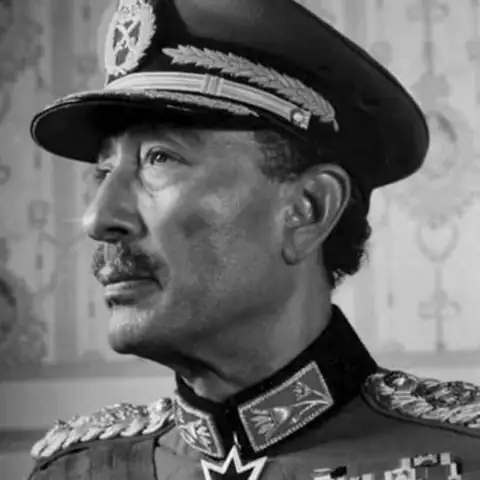
Who was Anwar Sadat?
Anwar Sadat was born in 1918 and became president of Egypt in 1970. In February 1971 he proposed reopening the Suez Canal in return for an Israeli pullback, and in July 1972 he expelled Soviet military advisers. On 6 October 1973 Egypt and Syria attacked Israeli forces. In November 1977 he offered to travel to Jerusalem, and at Camp David in September 1978 he joined Carter and Begin in two framework agreements. The Egyptian-Israeli treaty was signed on 26 March 1979. He was assassinated in October 1981.
Political views
- In February 1971 he offered to reopen the Suez Canal if Israeli forces withdrew from its east bank, and signaled he would end Egypt's claim of belligerency if Israel returned to the international border.Source: history.state.gov
- In July 1972 he expelled Soviet military advisers from Egypt and opened a back channel to Henry Kissinger through his national security adviser, Hafiz Isma'il.Source: history.state.gov
- In February 1973 his envoy told Kissinger that Egypt would sign a separate peace with Israel, but only after Israel left all territory occupied in 1967.Source: history.state.gov
- On 6 October 1973 Egypt and Syria attacked Israeli forces in Sinai and the Golan Heights, and Sadat rejected an early ceasefire proposed by Kissinger.Source: history.state.gov
- In November 1977 he offered to travel to Jerusalem, choosing direct talks with Israel over a Geneva conference.Source: history.state.gov
- At the Camp David summit of 5 to 17 September 1978 he reached two framework documents with Carter and Begin, covering a bilateral peace and a formula for Palestinian self-government in Gaza and the West Bank.Source: history.state.gov
Legacy
Supporters credit Sadat with ending the state of war between Egypt and Israel, regaining the Sinai for Egypt by negotiation and sharing the 1978 Nobel Peace Prize. Critics, in Egypt and across the Arab world, charged that he made a separate peace without securing a settlement for the Palestinians. Jordan and Saudi Arabia did not back the accords. He was assassinated in October 1981, and historians continue to argue about the repression and economic policies of his final years.