12axes-testTake the test
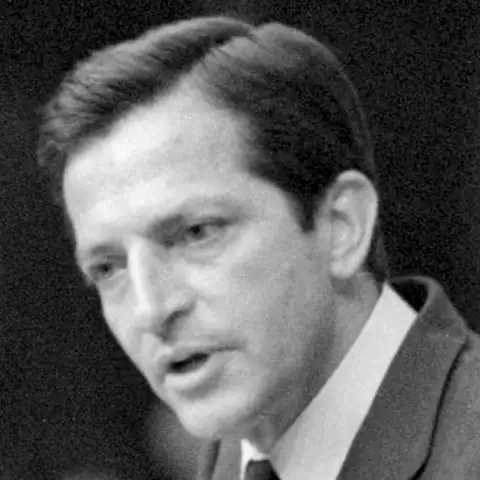
Adolfo Suárez
Historical figureSpain1932-2014

Adolfo Suárez

Prime Minister of Spain (1976-1981) · Leader of the Union of the Democratic Center

Spanish prime minister who rose in the Franco regime, then led the transition to democracy by legalizing parties, granting an amnesty and overseeing the 1978 constitution.

Profile on 12 axes6 of 12 documented
ECONOMYSTATESOCIETYWORLDOwnershipMarketsWelfareAuthoritySecurityStructureMoralityReligionTechnologyCultureTradeForeign
Where they stood

Adolfo Suárez, axis by axis

  1. 01OwnershipNo clear record
    PublicPrivate
  2. 02MarketsNo clear record
    PlannedFree
  3. 03WelfareNo clear record
    SharedSelf-reliant
  4. DemocraticStrong leader

    He rose in the Franco regime but then guided Spain to elections and a democratic constitution.

  5. LibertyOrder

    He legalized the Communist Party and parties and unions, and declared an amnesty for political prisoners.

  6. LocalCentral

    His government allowed all regions to set up self-government.

  7. ProgressiveTraditional

    His government backed a divorce law, passed months after he resigned, and repealed a 1933 law that criminalized homosexuality.

  8. SecularReligious

    Mild, from the divorce law and the end of Francoist institutions.

  9. 09TechnologyNo clear record
    EmbraceCaution
  10. MulticulturalNational identity

    Mild, from the recognition of regional self-government.

  11. 11TradeNo clear record
    GlobalProtected
  12. 12Foreign policyNo clear record
    CooperationStrength

6 axes have no clear record, so matching leaves them out.

Who was Adolfo Suárez?

Suárez was born in 1932 and made his career inside the Franco regime, serving as a regional governor and, from 1969, as director general of state radio and television. King Juan Carlos chose him as prime minister in 1976. In November 1976 he persuaded the Francoist Cortes to dissolve itself, which paved the way for the 1977 elections. In April 1977 he legalized the Communist Party. He led the Union of the Democratic Center to victory that year. Voters approved a new constitution in a December 1978 referendum. He announced his resignation in January 1981 and left office in February, and he died in March 2014 after about ten years with Alzheimer's.

Political views

  • In November 1976 he persuaded the Francoist Cortes to dissolve itself, which paved the way for the 1977 elections.Source: freiheit.org
  • In April 1977 he legalized the Communist Party, which the right-wing leader Manuel Fraga called a coup d'état.Source: freiheit.org
  • His government declared an amnesty for political prisoners and legalized the Communist Party.Source: en.escambray.cu
  • Voters approved the new constitution in December 1978 with 88 percent support.Source: freiheit.org
  • He oversaw the gradual decentralization of Spain, which let all regions set up self-governing institutions.Source: freiheit.org
  • His government backed a divorce law, approved months after his resignation, and repealed a 1933 law that criminalized homosexuality and drug use.Source: freiheit.org
  • Political figures across the spectrum credited him for his role during the attempted coup of 23 February 1981.Source: en.escambray.cu

Legacy

Admirers see Suárez as the man who steered Spain from dictatorship to democracy. He legalized parties, including the Communist Party, and left a constitution that has endured, and he was credited across the spectrum for his role during the 1981 coup attempt. Madrid's airport was renamed for him after his death. Critics point to his career inside the Franco regime and argue that the transition he led did not fully break with Francoism. His party was later eroded by rivals, and the Democratic and Social Center he founded in 1982 never won more than 20 seats in Congress.

How close are you to Adolfo Suárez?

Take the 12 Axes test and see which historical figure is your political twin, axis by axis.

Take the test

Adolfo Suárez: questions

Was Adolfo Suárez a Francoist?

He rose through the Franco regime as a regional governor and the director of state radio and television. After King Juan Carlos named him prime minister in 1976 he led Spain's move to democracy.

What did Adolfo Suárez do for Spanish democracy?

He persuaded the Francoist Cortes to dissolve itself, legalized parties including the Communist Party in 1977, and presided over the 1978 constitution.

Why did Adolfo Suárez resign?

He announced his resignation in January 1981 and left office in February.

Sources