12axes-testTake the test
Russell Kirk
Historical figureUnited States1918-1994

Russell Kirk

Political theorist and historian · Author of The Conservative Mind

American writer whose book The Conservative Mind traced a line of thought back to Edmund Burke and gave postwar traditionalist conservatism its intellectual roots.

Profile on 12 axesAll 12 documented
ECONOMYSTATESOCIETYWORLDOwnershipMarketsWelfareAuthoritySecurityStructureMoralityReligionTechnologyCultureTradeForeign
Where they stood

Russell Kirk, axis by axis

  1. PublicPrivate
  2. PlannedFree

    He tied freedom to property but distrusted ideology of every kind, market ideology included. So his markets score is only moderately free.

  3. SharedSelf-reliant
  4. DemocraticStrong leader
  5. LibertyOrder
  6. LocalCentral
  7. ProgressiveTraditional
  8. SecularReligious

    He saw a lasting moral order and thought religion central to culture, while insisting conservatism is not itself a creed or a doctrine.

  9. EmbraceCaution

    Scored from his rejection of television and computers, and from calling cars mechanical Jacobins.

  10. MulticulturalNational identity
  11. GlobalProtected

    Scored mildly protective because he backed Pat Buchanan in 1992, not because of detailed writing on trade. This is a judgment call.

  12. CooperationStrength

    He criticised the 1991 Gulf War and dreaded permanent war, but was also wary of internationalism. The two leanings partly cancel out.

Who was Russell Kirk?

Russell Kirk came from Plymouth, Michigan, where he was born in 1918. After Michigan State and Duke he earned a doctorate in Scotland, at St Andrews. His thesis turned into The Conservative Mind (1953), a survey of conservative thinkers running from Burke to Eliot. He then made his home in the village of Mecosta, producing books, essays and ghost tales. For a quarter of a century he wrote for National Review, and he launched the journals Modern Age and The University Bookman. In later life he became a Catholic. He died in 1994.

Political views

  • Believed there is a lasting moral order, and that conservatives should hold to custom, convention and continuity.Source: kirkcenter.org
  • Said policy should be led by prudence, which means weighing the likely long-term results of a measure above its popularity today.Source: kirkcenter.org
  • Saw freedom and property as closely tied, and held that owning property also brings duties.Source: kirkcenter.org
  • Favoured voluntary community and said decisions that affect people most directly should be taken locally, not by distant authority.Source: kirkcenter.org
  • Counted established religion among the traditions worth keeping.Source: plato.stanford.edu
  • Criticised the 1991 Gulf War, and in 1992 chaired Pat Buchanan's primary challenge in Michigan.Source: en.wikipedia.org
  • Opposed forced collectivism, and held that a central administration cannot give justice and prosperity to people who have lost their old responsibilities.Source: kirkcenter.org
  • Asked for sensible limits on power and on human passions, and said that conservatism should not be mistaken for a creed or a fixed set of doctrines.Source: kirkcenter.org

Legacy

Kirk is credited with giving American conservatism a history and a set of ideas, and with helping launch the modern movement, together with William F. Buckley Jr. In 1989 Ronald Reagan awarded him the Presidential Citizens Medal. Admirers value how much weight he put on culture, community and the moral imagination. Critics, among them the philosopher Harry Jaffa, disputed his reading of Burke. Libertarians and neoconservatives often objected to his suspicion of ideology, markets and military adventures abroad.

In their own words

“In a genuine community, the decisions most directly affecting the lives of citizens are made locally and voluntarily.”
Ten Conservative Principles, adapted from The Politics of Prudence, 1993

How close are you to Russell Kirk?

Take the 12 Axes test and see which historical figure is your political twin, axis by axis.

Take the test

Russell Kirk: questions

What are Russell Kirk's ten principles of conservatism?

Among them are a lasting moral order, respect for custom, prudence, variety, human imperfection, freedom tied to property, voluntary community, limits on power, and a balance of permanence and change.

Was Russell Kirk a Republican?

He leaned to the right of the Republican Party and supported Pat Buchanan's 1992 challenge. He was never a party loyalist, though, and he distrusted ideology of any sort.

What is The Conservative Mind about?

It is Kirk's 1953 study of conservative ideas in Britain and America, starting with Burke. It helped give the postwar conservative movement a past to draw on.

Sources

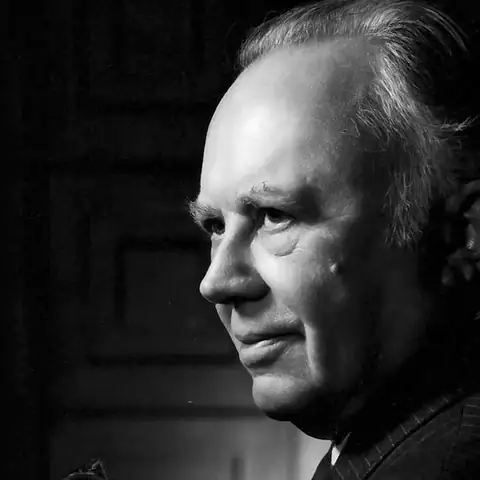
Portrait: Russell Kirk.jpg by Unknown author, CC BY 2.5, via Wikimedia Commons. Cropped and converted to grayscale by 12axes-test.com.