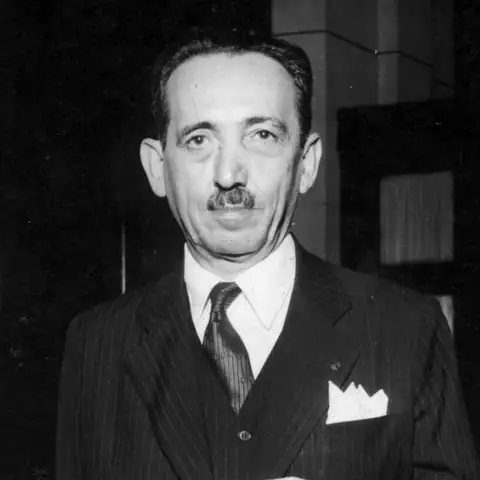
Who was Plínio Salgado?
Salgado was born on 22 January 1895 in São Bento do Sapucaí, in São Paulo state, and worked as a teacher, journalist and novelist. After a 1930 trip to Europe, where he met Mussolini, he turned to fascist-inspired politics. He founded Brazilian Integralist Action in 1932 and led it as national chief until Getúlio Vargas dissolved it in December 1937. He was involved in the failed integralist uprising of May 1938 and was exiled to Portugal from 1939 until August 1945. He then co-founded the Party of Popular Representation, won about 8 percent of the vote for president in 1955 and served in congress from 1959 to 1974. He died in São Paulo in 1975.
Political views
- The Integralist founding manifesto appeared in October 1932, and Salgado became the movement's national chief in March 1934.Source: www18.fgv.br
- The movement sought an integral corporatist state. Only producers would vote and class representation would replace parties. Salgado's version was family-corporatist.Source: www18.fgv.br
- Nationalism was its central idea, mostly cultural and romantic, and the motto was God, Fatherland and Family. Its doctrine rested on a spiritualist humanism with a Catholic background.Source: www18.fgv.br
- Its 1933 founding book declared war on liberal democracy. Its attacks on capitalism targeted international financial capital, not private property or profit.Source: www18.fgv.br
- The statutes made Salgado's position as national chief permanent, and a personality cult grew built on his oratory and absolute authority.Source: www18.fgv.br
- Antisemitism was present in the movement, though not shared by all its thinkers. Gustavo Barroso was its most radical antisemite.Source: www18.fgv.br
- Estimates put the movement at 600,000 to one million adherents by 1936. After the Estado Novo coup, Vargas dissolved it in December 1937.Source: www18.fgv.br
- He was involved in the failed May 1938 uprising and was exiled to Portugal from June 1939 until August 1945. He later won roughly 8 percent for president in 1955 and was a federal deputy from 1959 to 1974, joining ARENA in 1965.Source: www18.fgv.br
Legacy
A Brazilian university archive calls Integralism the most important fascist-inspired movement organized in Brazil, and Salgado was its unchallenged chief. Supporters saw a prolific writer and journalist who defended God, family and nation against communism. Critics point to its declared war on liberal democracy, its green-shirted street politics, a leader cult, antisemitism among its militants and the armed attack on the presidential palace in 1938. Salgado later worked inside elected institutions, but he never won the presidency, and his party took only about 8 percent in 1955.