12axes-testTake the test
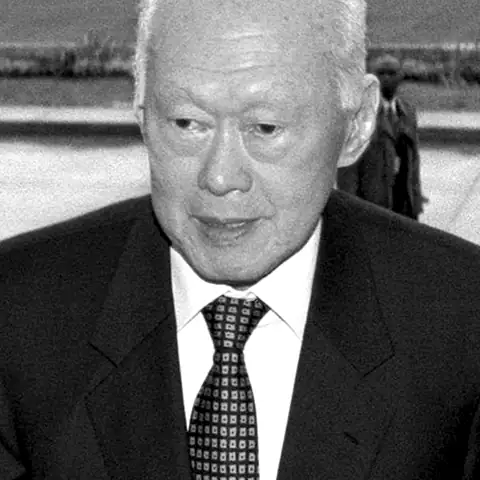
Lee Kuan Yew
Historical figureSingapore1923-2015

Lee Kuan Yew

1st Prime Minister of Singapore (1959-1990) · Co-founder of the People's Action Party

Singapore's founding prime minister, who led the city-state for three decades, built a rich trading economy and a clean, orderly society, and kept tight control over opponents and the press.

Profile on 12 axesAll 12 documented
ECONOMYSTATESOCIETYWORLDOwnershipMarketsWelfareAuthoritySecurityStructureMoralityReligionTechnologyCultureTradeForeign
Where they stood

Lee Kuan Yew, axis by axis

  1. PublicPrivate

    Mixed a welcome for foreign private capital with large government-linked firms and state housing, so the score is near the middle.

  2. PlannedFree
  3. SharedSelf-reliant
  4. DemocraticStrong leader
  5. LibertyOrder
  6. LocalCentral

    Singapore is a city-state. The central score therefore reflects one dominant party and one national government, not a decision against regional power.

  7. ProgressiveTraditional
  8. SecularReligious
  9. EmbraceCaution
  10. MulticulturalNational identity

    The state officially backed equal treatment of Chinese, Malay and Indian communities. At the same time it pushed national unity and gave rising weight to Chinese and Confucian values. This is a judgment call.

  11. GlobalProtected
  12. CooperationStrength

    Took a hard-headed approach, with conscription and a strong military, but also helped found ASEAN. The score leans mildly toward strength.

Who was Lee Kuan Yew?

Lee was a Singaporean, born in 1923, who trained in law at Cambridge. At home he practised as a barrister, often acting for unions. He helped found the People's Action Party (PAP) in 1954. The PAP won the 1959 election and Lee became prime minister of a self-governing colony. He took Singapore into Malaysia in 1963. Two years later it was forced out and became a fully independent state. He held the top job until 1990. After that he stayed in cabinet with senior titles until 2011. He died in 2015, aged 91.

Political views

  • Drew in multinational firms and foreign money for jobs, and had the state provide public flats, a compulsory savings scheme and big government-linked companies.Source: theguardian.com
  • Promoted a multiracial state in which Chinese, Malay and Indian citizens were meant to be treated alike in language, culture and faith.Source: nas.gov.sg
  • Argued that a tiny country next to bigger ones must be able to protect itself. This led to conscription and a well-equipped army.Source: nas.gov.sg
  • Kept the power to detain people without trial under security laws, and in the early 1960s his government jailed many left-wing opponents.Source: theguardian.com
  • Sued critics and publications for defamation, including the Far Eastern Economic Review in a 2008 case.Source: news.bbc.co.uk
  • Credited east Asia's rise to discipline, order and deference to authority, a theory known as Asian values.Source: theguardian.com
  • Wanted a non-communist, independent Malaya, and joined Singapore to Malaysia in 1963, before the split of 1965.Source: theguardian.com

Legacy

Singapore went from a modest port to one of the richest countries in the world during and after his years in power. Admirers credit his government with honest administration, good housing and schools, and peace between ethnic groups. Officially he is honored as the founding prime minister. Rights groups and other critics point to detention without trial, a controlled press and defamation suits that bankrupted opposition figures. They also object to schemes that rewarded graduate mothers, which they call social engineering. People still argue about how much of the country's success came from his methods.

In their own words

“We are going to have a multi-racial nation in Singapore. We will set the example. This is not a Malay nation; this is not a Chinese nation; this is not an Indian nation.”
Press conference on Singapore's separation from Malaysia, 9 August 1965

How close are you to Lee Kuan Yew?

Take the 12 Axes test and see which historical figure is your political twin, axis by axis.

Take the test

Lee Kuan Yew: questions

Was Lee Kuan Yew a dictator?

Critics call his rule authoritarian. Elections were held, but his party won every time, and he limited the press and opposition through detention, lawsuits and other legal tools. Supporters say he delivered clean and effective government.

Did Lee Kuan Yew support democracy?

He doubted that Western-style liberal democracy suited Singapore. He argued that order, discipline and strong government came first, and he spoke of Asian values. Critics say that was a cover for keeping power.

What did Lee Kuan Yew do for Singapore?

He led it from a trading port to a wealthy country with low corruption, good public housing and schools, and a stable mix of races. His methods against opponents remain disputed.

Sources