12axes-testTake the test
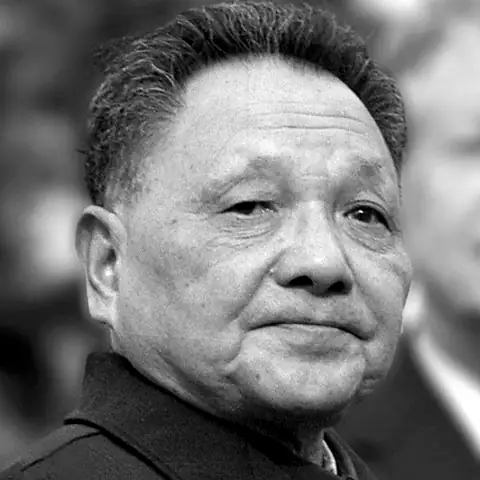
Deng Xiaoping
Historical figureChina1904-1997

Deng Xiaoping

Paramount leader of the People's Republic of China (1978-1989) · Chairman of the Central Military Commission

Chinese Communist leader who turned China away from Mao's planned economy toward markets and foreign investment, held on to one-party rule and approved the violent 1989 Tiananmen crackdown.

Profile on 12 axes10 of 12 documented
ECONOMYSTATESOCIETYWORLDOwnershipMarketsWelfareAuthoritySecurityStructureMoralityReligionTechnologyCultureTradeForeign
Where they stood

Deng Xiaoping, axis by axis

  1. PublicPrivate

    He allowed markets, private business and foreign money, yet kept the key industries under the state in 'socialism with Chinese characteristics'. That puts him toward public ownership, but well short of Mao.

  2. PlannedFree
  3. 03WelfareNo clear record
    SharedSelf-reliant
  4. DemocraticStrong leader

    Party leadership was a non-negotiable principle of his reforms, and he sent the army into Tiananmen Square in 1989. He scores very high on strong leadership.

  5. LibertyOrder
  6. LocalCentral

    He gave provinces and firms more say over economic choices, but he kept a one-party state run from the center. He scores toward central.

  7. 07MoralityNo clear record
    ProgressiveTraditional
  8. SecularReligious

    He upheld Marxism, one of his Four Cardinal Principles, in a state that was officially atheist, although his reforms eased some of Mao's limits. This one is a judgment call.

  9. EmbraceCaution
  10. MulticulturalNational identity
  11. GlobalProtected
  12. CooperationStrength

    He reopened ties with Washington and Western countries, yet he also ordered the 1979 attack on Vietnam. He scores mildly toward strength.

2 axes have no clear record, so matching leaves them out.

Who was Deng Xiaoping?

Deng Xiaoping came from Sichuan, where he was born in 1904. As a young worker-student in France he joined the communist movement. He fought through the revolution and civil war, and after 1949 he rose to vice premier and then party general secretary. Hardliners removed him from office twice, once in the Cultural Revolution and once more in 1976. He came back in 1977 and by late 1978 was the country's top leader. He then opened China to trade and private business. He held the real power until he died in 1997, though he never took the title of head of state.

Political views

  • He let farm families work their own plots instead of in collectives, and he encouraged private entrepreneurs. This started what the party called market socialism.Source: latimes.com
  • From 1980 he set up Special Economic Zones, where foreign firms were invited to invest under looser market rules.Source: en.wikipedia.org
  • He put forward the Four Modernisations, a plan to upgrade farming, industry, the armed forces, and science and technology.Source: news.bbc.co.uk
  • He set four red lines for reform. The party must lead, China must stay on the socialist path, Marxist thought must guide it and the proletariat's dictatorship must remain.Source: en.wikipedia.org
  • He came up with 'one country, two systems' to bring Hong Kong and Macau back under Chinese rule, and he held it out as a model for Taiwan.Source: en.wikipedia.org
  • He was a leading figure in the Anti-Rightist Campaign of 1957. Officially at least 550,000 people were persecuted, and the campaign hardened one-party rule.Source: en.wikipedia.org
  • In June 1989 he and several senior party veterans sent troops to empty Tiananmen Square by force.Source: news.bbc.co.uk

Legacy

Supporters say Deng ended the turmoil of the Mao years and set China on a path of fast growth that made it a leading economy. Time magazine put him on its Person of the Year cover twice, in 1978 and 1985. Critics answer that he guarded the party's grip on power and had the 1989 democracy protests crushed. Beijing reported about 200 civilian deaths and a few dozen among security forces. Other estimates run from several hundred to more than 1,000, and one British diplomatic cable gave 10,000 or more. He also carries blame for the Anti-Rightist Campaign and for other repression under Mao.

In their own words

“Whether a cat is black or white makes no difference as long as it catches mice.”
Remark from before he became paramount leader, as quoted by the Los Angeles Times, 1989

How close are you to Deng Xiaoping?

Take the 12 Axes test and see which historical figure is your political twin, axis by axis.

Take the test

Deng Xiaoping: questions

Was Deng Xiaoping a capitalist?

No. He was a lifelong communist who brought in market tools, private business and foreign investment to grow the economy. He called the result socialism with Chinese characteristics and kept the party in control.

What did Deng Xiaoping do at Tiananmen Square?

In 1989 Deng and a circle of senior party veterans told the army to end the pro-democracy protests in Beijing. Troops shot at crowds on the night of 3-4 June, and at least hundreds died. The true number is still unknown, and the subject is censored in China.

What is 'one country, two systems'?

It is Deng's idea that a region can return to Chinese rule yet keep its own economic and legal system. It was applied to Hong Kong and Macau, and Deng also offered it to Taiwan.

Sources