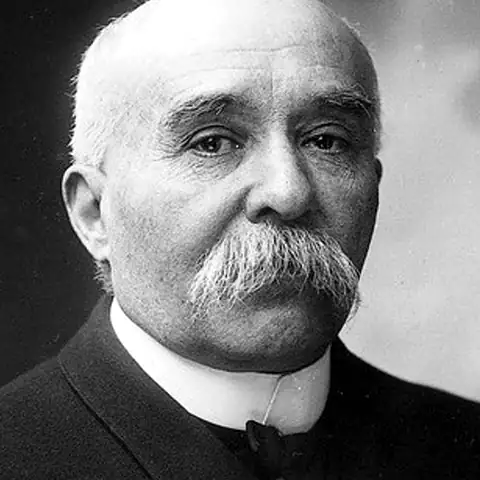
Who was Georges Clemenceau?
Georges Clemenceau, a doctor turned politician, was a Radical republican on the far left of the French Chamber. He led the 1880 amnesty campaign for Communards and brought down Jules Ferry's government over colonial policy. As editor of L'Aurore he published Zola's 'J'accuse' in 1898 and campaigned for Dreyfus. He was premier from 1906 to 1909, and again from November 1917, when he led France to victory in the First World War. He chaired the 1919 Paris Peace Conference, lost the next election and died in Paris in 1929.
Political views
- Called for secular compulsory primary education and the separation of church and state in his 1876 platform, and supported anticlerical laws as premier.Source: universalis.fr
- Championed legalizing divorce and backed anticlerical legislation through his paper La Justice.Source: encyclopedia.com
- Opposed Jules Ferry's colonial expansion in the 1880s, though after 1918 he secured French trusteeship of Syria and Lebanon.Source: newworldencyclopedia.org
- Published Zola's 'J'accuse' on 13 January 1898 and fought for years to clear Alfred Dreyfus.Source: newworldencyclopedia.org
- As premier he sent troops against the 1906 miners' strike and suppressed the 1907 winegrowers' revolt, earning the nickname chief cop of France.Source: encyclopedia.com
- Adopted a policy of total war in 1917 and had the politician Joseph Caillaux arrested for opposing the war effort.Source: newworldencyclopedia.org
- At Paris in 1919 he argued that German control of the Rhineland left France without a natural eastern frontier. The settlement gave France the Saar mines for 15 years and an Allied occupation of the Rhineland.Source: newworldencyclopedia.org
Legacy
Admirers remember Clemenceau as the wartime leader who held a weary nation together in 1917 and 1918 and earned the title Father of Victory. He is also credited for defending Dreyfus and for lasting secular, republican institutions. Critics note his harsh handling of strikes at home, where he used the army, and wartime arrests of opponents such as Caillaux. Others say he was too severe on Germany at Versailles, though he himself doubted the treaty would prevent another war. French voters felt he had not won enough, and he lost the next election. Keynes judged that he had one illusion, France, and one disillusion, mankind.