12axes-testTake the test
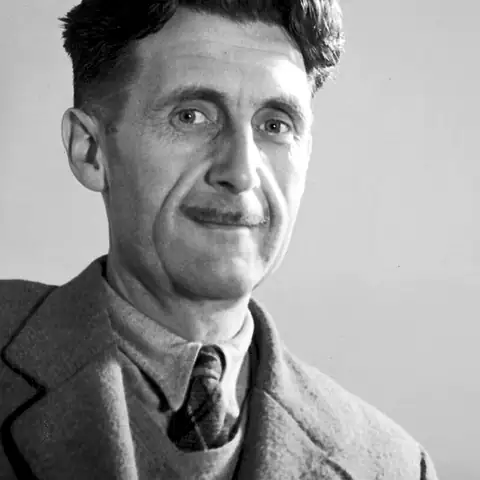
George Orwell
Historical figureUnited Kingdom1903-1950

George Orwell

Novelist · Essayist

Orwell was an English writer and democratic socialist who attacked both empire and dictatorship. He is best known for the novels Animal Farm and Nineteen Eighty-Four.

Profile on 12 axes10 of 12 documented
ECONOMYSTATESOCIETYWORLDOwnershipMarketsWelfareAuthoritySecurityStructureMoralityReligionTechnologyCultureTradeForeign
Where they stood

George Orwell, axis by axis

  1. PublicPrivate
  2. PlannedFree
  3. SharedSelf-reliant
  4. DemocraticStrong leader
  5. LibertyOrder
  6. 06StructureNo clear record
    LocalCentral

    No clear position on central versus local government is documented, so this axis is left empty.

  7. ProgressiveTraditional

    In daily life he was fairly conventional and poked fun at some progressive fashions, yet he defended personal freedom. The score is close to neutral.

  8. SecularReligious
  9. EmbraceCaution

    He distrusted what he called the machine civilization and feared that technology could serve surveillance, though he did not turn against industry.

  10. MulticulturalNational identity

    He valued a defensive patriotism, rejected aggressive nationalism and opposed British rule over other peoples.

  11. 11TradeNo clear record
    GlobalProtected

    No clear position on tariffs is documented, so this axis is left empty.

  12. CooperationStrength

    He rejected pacifism in the Second World War. He wanted to resist fascism and Soviet expansion, and he also called for a united Europe.

2 axes have no clear record, so matching leaves them out.

Who was George Orwell?

George Orwell was the pen name of Eric Blair, who was born in India in 1903 and went to school at Eton. He spent five years as a police officer in British Burma, and the job left him hostile to empire. Back in Europe he wrote about poor people in Down and Out in Paris and London and The Road to Wigan Pier. In Spain in 1937 he fought for the Republic with the POUM militia, was shot in the throat and saw communists crush his comrades. He told that story in Homage to Catalonia. He later worked at the BBC and the Tribune magazine, and his last two novels made him world famous. He died in 1950.

Political views

  • He called for the state to take over land, mines, railways, banks and the big industries. He also wanted a cap on incomes of ten to one.Source: gutenberg.net.au
  • He said that from 1936 on, every serious line he wrote was against dictatorship and for democratic socialism.Source: orwellfoundation.com
  • He defended a free press and blamed British writers who stayed silent about the Soviet Union.Source: orwellfoundation.com
  • He argued that India should get Dominion status straight away, with a right to leave the Empire.Source: gutenberg.net.au
  • He drew a line between patriotism, which is love of a place and way of life, and nationalism, which he saw as a thirst for power.Source: orwellfoundation.com
  • He backed the fight against Nazi Germany and held that being a patriot did not make a person a conservative.Source: orwellfoundation.com

Legacy

Words from Orwell, such as Big Brother, doublethink and Orwellian, are now part of everyday speech, and schools teach his essays as models of clear writing. People across the spectrum claim him. Socialists stress his democratic socialism and his dislike of empire, while conservatives and Cold War liberals stress his hatred of communism. In 1949 he gave a Foreign Office propaganda unit a list of writers he thought were communist sympathizers. Critics on the left call that informing. Defenders say the list was only meant to keep those writers out of anti-communist work. Some also point to rude remarks he made about certain groups. His books remain central to debates about surveillance and propaganda.

In their own words

“Every line of serious work that I have written since 1936 has been written, directly or indirectly, against totalitarianism and for democratic socialism, as I understand it.”
Why I Write, 1946
“If liberty means anything at all it means the right to tell people what they do not want to hear.”
The Freedom of the Press, proposed preface to Animal Farm, 1945

How close are you to George Orwell?

Take the 12 Axes test and see which historical figure is your political twin, axis by axis.

Take the test

George Orwell: questions

Was George Orwell a socialist?

Yes. He called himself a democratic socialist and wanted the major industries under public ownership. He also despised Soviet communism, and that mix is why people on both sides of politics claim him.

Did George Orwell belong to a party?

He joined the Independent Labour Party in 1938 but left it because it opposed fighting the Second World War. In Spain he served in the militia of the POUM, a party linked to the ILP.

What is totalitarianism in Orwell's books?

In Nineteen Eighty-Four it means a state that controls facts, language and even private thought. Orwell thought both fascist and Soviet systems worked this way.

Sources

Portrait: George Orwell, c. 1940 (41928180381).jpg by Cassowary Colorizations, CC BY 2.0, via Wikimedia Commons. Cropped and converted to grayscale by 12axes-test.com.