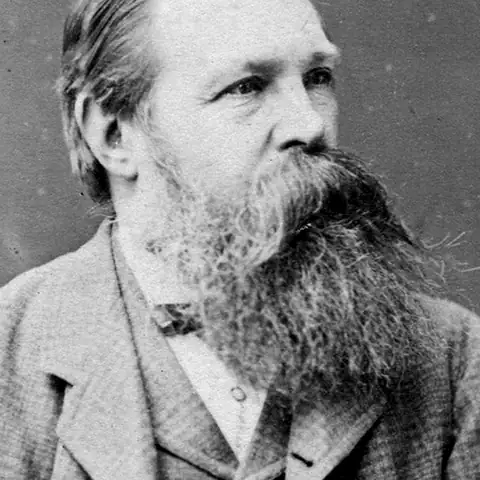
Who was Friedrich Engels?
Friedrich Engels grew up in Barmen, in Prussia, the son of a textile manufacturer. His father sent him to work at the family's cotton mill in Manchester, England, where he saw how the workers lived. He turned that experience into The Condition of the Working Class in England in 1845. A year earlier he had met Karl Marx, and the two became lifelong partners. Together they wrote The Communist Manifesto in 1848. Engels paid Marx's bills for years, finished the later volumes of Capital after Marx died and guided the socialist parties of Europe. He died in London in 1895.
Political views
- Described the poverty, child labor and crowded slums of industrial Manchester as proof that early capitalism harmed workers.Source: marxists.org
- Argued for common ownership of factories, land and other means of production, and called his approach scientific socialism, in contrast to the dreams of the utopians.Source: marxists.org
- Held that revolution is an act of authority, and that large-scale industry needs some chain of command and coordination.Source: marxists.org
- Expected the state to fade away gradually once workers held power, rather than being abolished in a single stroke.Source: marxists.org
- Traced the single-partner family, and the lower place of women in it, back to the rise of private property.Source: marxists.org
- Backed a materialist and dialectical account of nature and history, and argued it against rival socialist schools.Source: marxists.org
Legacy
Engels taught Marxism to millions. German social democrats, and later Soviet Marxist-Leninists, treated his popular books as core texts, and his work on the family inspired socialist feminists and anthropologists. Some interpreters, starting with Georg Lukács, say he made Marx's thought more mechanical and fixed, though other scholars dispute that split. Liberal and conservative critics blame him, together with Marx, for the ideas that communist regimes later used. Admirers value his Manchester study as an early piece of fact-based social research. Historians also note the irony that a factory owner's income paid for the writing against capitalism. He is still read on urban poverty, working conditions and family history.
In their own words
“The State is not 'abolished'. It dies out.”