12axes-testTake the test
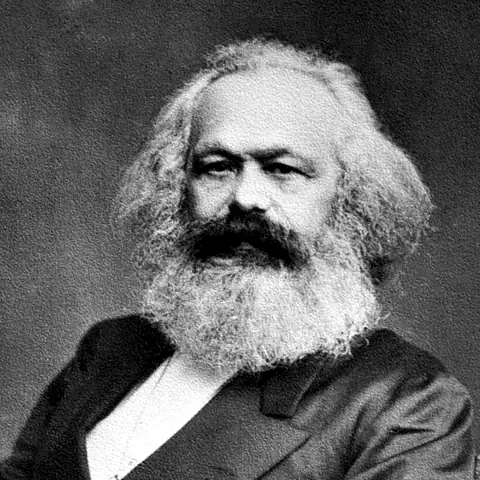
Karl Marx
Historical figureGermany1818-1883

Karl Marx

Philosopher · Economist

German thinker whose analysis of capitalism and class struggle, set out in Capital and The Communist Manifesto, founded Marxism and inspired many communist movements.

Profile on 12 axesAll 12 documented
ECONOMYSTATESOCIETYWORLDOwnershipMarketsWelfareAuthoritySecurityStructureMoralityReligionTechnologyCultureTradeForeign
Where they stood

Karl Marx, axis by axis

  1. PublicPrivate
  2. PlannedFree
  3. SharedSelf-reliant
  4. DemocraticStrong leader

    He called for a 'dictatorship of the proletariat' yet admired the elected, recallable bodies of the Paris Commune. Readers therefore see him anywhere from radically democratic to authoritarian.

  5. LibertyOrder
  6. LocalCentral

    In the Manifesto, credit and production are gathered in the state's hands. In his writing on the Commune, though, he praised self-government at the local level.

  7. ProgressiveTraditional
  8. SecularReligious
  9. EmbraceCaution
  10. MulticulturalNational identity
  11. GlobalProtected

    His 1848 support for free trade was tactical. He expected it to hasten social revolution, and he did not value it as an economic ideal.

  12. CooperationStrength

    He wanted workers of all countries to stand together and accepted revolutionary force. He left no clear stance on diplomacy against military strength.

Who was Karl Marx?

Born in Trier, a town in the Prussian Rhineland, Karl Marx studied law and then philosophy, first at Bonn and then at Berlin, where Hegel's thinking left its mark. Working as a radical journalist, he was thrown out of Germany, France and Belgium in turn, and from 1849 he lived in London until he died. In 1848 he and his friend Friedrich Engels published the Manifesto of the Communist Party. His main economic study, the first volume of Capital, came out in 1867. It treats capitalism as a system built on extracting surplus value from paid labour. He was also a leading figure in the First International.

Political views

  • Saw history as moved by struggle between classes, and expected capitalism to give way to a society with no classes.Source: marxists.org
  • Taught that wage labour is exploitation, since workers create more value than they receive in pay.Source: marxists.org
  • Called for an end to private ownership of the means of production, though not of personal possessions.Source: marxists.org
  • Sketched a transition period of 'dictatorship of the proletariat', then a final stage of plenty, where each gives what they can and takes what they need.Source: marxists.org
  • Pointed to the Paris Commune of 1871, whose delegates were elected and could be recalled, as a model for government by workers.Source: marxists.org
  • Argued that religion grows out of social conditions, and called it 'the opium of the people'.Source: marxists.org
  • Spoke up for free trade in 1848, since he thought it would make class conflict sharper and bring revolution closer.Source: marxists.org

Legacy

Few thinkers have had more influence. Lenin, Mao and other rulers of 20th-century communist states called their regimes Marxist. Scholars still argue about how far those one-party systems matched what Marx wrote. Social democrats, Western Marxists, sociologists and historians have borrowed his ideas about class, crises and alienation without accepting revolution. Karl Popper said Marxist predictions could never be tested. The economists Mises and Hayek said a socialist economy cannot price things well. Conservatives connect his ideas with the repression and famines under communist governments. Admirers point to his effect on workers' rights and on the study of inequality.

In their own words

“The philosophers have only interpreted the world, in various ways; the point is to change it.”
Theses on Feuerbach, thesis XI, 1845

How close are you to Karl Marx?

Take the 12 Axes test and see which historical figure is your political twin, axis by axis.

Take the test

Karl Marx: questions

Was Karl Marx a communist?

Yes. With Engels he wrote the Manifesto of the Communist Party, and he aimed at a classless society with no private ownership of productive property. The regimes that later called themselves communist did not all follow his writing, and historians still debate that.

What is Marxism in simple terms?

Marxism holds that society is shaped by conflict between classes, chiefly owners and workers. Marx said capitalism exploits workers and that struggle would replace it, first with a workers' state and later with communism.

Did Karl Marx start a political party?

Not a national party. In 1848 he co-wrote the programme for the Communist League, and from 1864 he helped to lead the International Workingmen's Association. German social democrats, and later communist parties, took up his ideas.

Sources