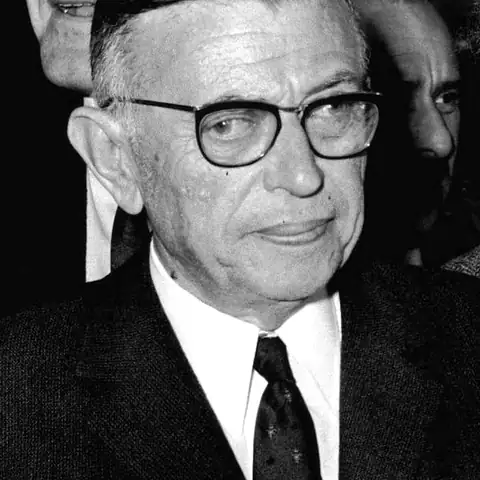
Who was Jean-Paul Sartre?
Sartre was a Parisian, born in 1905. Before the war he taught philosophy in Le Havre. The German army captured him in 1940 and held him for close to a year. His big work Being and Nothingness came out in 1943. After the liberation of France he became its most famous public thinker, and he launched the review Les Temps modernes. He never joined the French Communist Party, yet in his Critique of Dialectical Reason of 1960 he tried to fit existentialism together with Marxism. In 1964 he turned down the Nobel Prize in Literature. He died in Paris in 1980.
Political views
- He taught that people are completely free and so answerable for their situations, including shared ones like racism and empire.Source: plato.stanford.edu
- He called historical materialism the only sound reading of history, but rejected a rigid Marxism that treats people like objects.Source: plato.stanford.edu
- He sided with Algeria's FLN and put his name to the Manifesto of the 121. In 1961 the OAS set off a bomb at his apartment building.Source: en.wikipedia.org
- In 1961 he wrote the preface for Frantz Fanon's The Wretched of the Earth, and it seemed to approve of violence by colonized peoples.Source: plato.stanford.edu
- Together with Bertrand Russell he organized a 1967 tribunal that put American conduct in Vietnam on trial.Source: en.wikipedia.org
- After 1968 he sided with French Maoists and sold their banned paper, La Cause du peuple, in the street.Source: en.wikipedia.org
Legacy
Sartre is the best-known name in existentialism. His thoughts on freedom, bad faith and responsibility shaped philosophy, fiction and the postwar left. Admirers value his backing for anticolonial causes, in Algeria and elsewhere, his refusal of official honors and his belief that thinkers should speak out. Critics, among them his former friend Albert Camus, say he excused Soviet repression. In 1950 he wrote that writing about the Soviet labor camps was not his duty. Many also condemn his Fanon preface as glorifying killing, and they call his Maoist ties and his shifting line on Hungary in 1956 poor political judgment.
In their own words
“a writer should not allow himself to be turned into an institution”