12axes-testTake the test
Yasser Arafat
Historical figurePS1929-2004

Yasser Arafat

Chairman of the Palestine Liberation Organization · President of the Palestinian National Authority (1994-2004)

Palestinian national leader who headed the PLO, signed on to mutual recognition with Israel in the 1993 Oslo process and became the first president of the Palestinian Authority.

Profile on 12 axes6 of 12 documented
ECONOMYSTATESOCIETYWORLDOwnershipMarketsWelfareAuthoritySecurityStructureMoralityReligionTechnologyCultureTradeForeign
Where they stood

Yasser Arafat, axis by axis

  1. 01OwnershipNo clear record
    PublicPrivate
  2. 02MarketsNo clear record
    PlannedFree
  3. 03WelfareNo clear record
    SharedSelf-reliant
  4. DemocraticStrong leader
  5. LibertyOrder

    For decades the organization he led treated armed struggle as its main path, then renounced terrorism in 1993.

  6. LocalCentral
  7. 07MoralityNo clear record
    ProgressiveTraditional
  8. SecularReligious

    The PLO was a secular nationalist body.

  9. 09TechnologyNo clear record
    EmbraceCaution
  10. MulticulturalNational identity

    Palestinian national identity was the center of his politics, and the PLO charter stresses it.

  11. 11TradeNo clear record
    GlobalProtected
  12. CooperationStrength

    He moved from armed struggle to negotiation. The Oslo texts show diplomacy and recognition, while the earlier charter shows force.

6 axes have no clear record, so matching leaves them out.

Who was Yasser Arafat?

Arafat led the Palestine Liberation Organization, an umbrella body whose 1968 charter called armed struggle the only way to liberate Palestine. In September 1993 the PLO renounced terrorism and recognized Israel's right to exist in peace, and Israel accepted the PLO as the representative of the Palestinians. The Oslo Declaration of Principles that followed set up a Palestinian council for an interim period of up to five years, with the hardest questions left for later talks. Arafat then served as president of the new Palestinian Authority until his death in 2004. Negotiations with Israel in the years after Oslo did not reach a final settlement.

Political views

  • The PLO's 1968 National Charter declared that armed struggle is the only way to liberate Palestine.Source: avalon.law.yale.edu
  • The same charter defined Palestine by its British Mandate borders and called the 1947 partition and the creation of Israel illegal.Source: avalon.law.yale.edu
  • It described Zionism as a political movement tied to imperialism and urged states to treat it as illegitimate.Source: avalon.law.yale.edu
  • In the 1993 Oslo process the PLO renounced terrorism and recognized Israel's right to exist in peace.Source: history.state.gov
  • Israel in turn accepted the PLO as the representative of the Palestinian people.Source: history.state.gov
  • The Declaration of Principles provided for an elected Palestinian council for an interim period of no more than five years, leading to a final settlement based on UN Security Council Resolutions 242 and 338.Source: avalon.law.yale.edu
  • It left Jerusalem, refugees, settlements and borders for later talks, and it started the handover of powers from Israeli military administration with Gaza and Jericho.Source: avalon.law.yale.edu
  • Later steps included the Cairo agreement of 1994, the Oslo II agreement of 1995, the Wye River memorandum of 1998 and the Sharm el-Sheikh memorandum of 1999. The Camp David summit of July 2000 failed to reach a final agreement.Source: history.state.gov

Legacy

Admirers see Arafat as the leader who made the Palestinian cause an international one and who took the PLO from armed struggle to negotiation and a limited form of self-rule. Critics, including many Israelis, hold that the PLO under his leadership carried out attacks on civilians for decades and that violence did not end after 1993. Palestinian critics fault the Authority's handling of power and the stalled path to statehood.

How close are you to Yasser Arafat?

Take the 12 Axes test and see which historical figure is your political twin, axis by axis.

Take the test

Yasser Arafat: questions

Did Yasser Arafat recognize Israel?

In 1993 the PLO recognized Israel's right to exist in peace and renounced terrorism, and Israel accepted the PLO as the representative of the Palestinians. The Oslo process followed.

What did the Oslo Accords agree?

They set up an elected Palestinian council for an interim period of up to five years, a gradual handover of powers starting with Gaza and Jericho, and later talks on Jerusalem, refugees, settlements and borders.

Why did the Camp David summit of 2000 matter?

It was a July 2000 attempt to reach a final agreement between Israel and the Palestinians. It failed, and blame is not assigned to a single side.

Sources

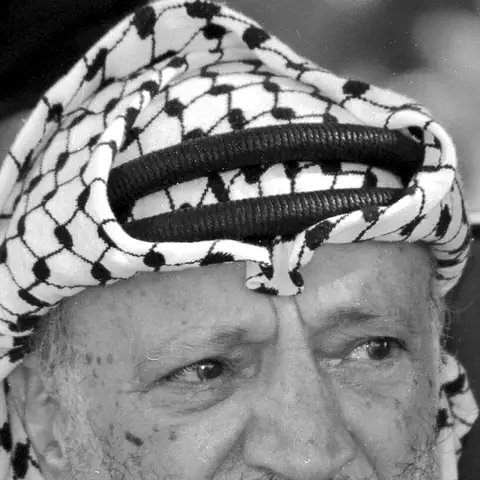
Portrait: Leader of the PLO, Yasser Arafat, 1996 Dan Hadani Archive.jpg by Gideon Markowiz, CC BY 4.0, via Wikimedia Commons. Cropped and converted to grayscale by 12axes-test.com.