12axes-testTake the test
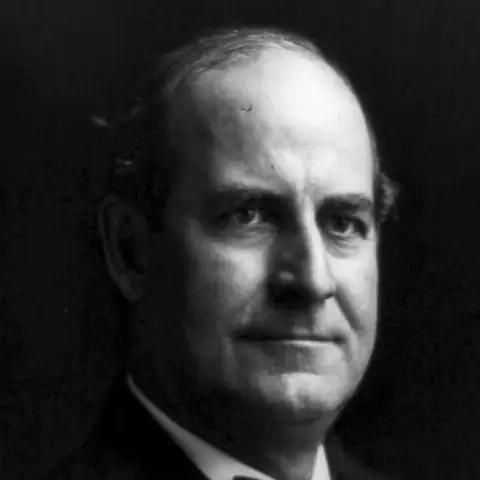
William Jennings Bryan
Historical figureUnited States1860-1925

William Jennings Bryan

U.S. Representative from Nebraska (1891-1895) · Democratic presidential nominee (1896, 1900, 1908)

Three-time Democratic nominee for president who pushed free silver, the income tax and opposition to empire, then spent his last years fighting the teaching of evolution.

Profile on 12 axes11 of 12 documented
ECONOMYSTATESOCIETYWORLDOwnershipMarketsWelfareAuthoritySecurityStructureMoralityReligionTechnologyCultureTradeForeign
Where they stood

William Jennings Bryan, axis by axis

  1. PublicPrivate

    For a short time after 1906 he supported government ownership of railroads, then gave up the idea when his party pushed back. Otherwise he preferred regulating industry to owning it.

  2. PlannedFree
  3. SharedSelf-reliant
  4. DemocraticStrong leader
  5. LibertyOrder
  6. LocalCentral

    Michael Kazin, a historian, calls him the first major-party leader to make the case for permanently larger federal power on behalf of ordinary people.

  7. ProgressiveTraditional
  8. SecularReligious

    He campaigned for state bans on teaching evolution in public schools, and at the Scopes trial he spoke in support of Tennessee's Butler Act.

  9. 09TechnologyNo clear record
    EmbraceCaution
  10. MulticulturalNational identity

    He went along with the Jim Crow system and helped sink a 1924 convention motion against the Ku Klux Klan. That weighs on this score.

  11. GlobalProtected
  12. CooperationStrength

    A firm anti-imperialist and treaty-maker for peace. Yet his time as Secretary of State saw interventions in Haiti, the Dominican Republic and Mexico.

One axis has no clear record, so matching leaves it out.

Who was William Jennings Bryan?

Raised in Illinois, Bryan became a lawyer, moved to Nebraska and won two House terms. At 36 he gave the Cross of Gold speech at the 1896 convention and was nominated for president, which made him the youngest major-party candidate ever. McKinley beat him in 1896 and again in 1900, and Taft beat him in 1908. Even in defeat he led the farm-based, populist wing of his party. President Wilson made him Secretary of State. Bryan resigned in 1915. Afterwards he threw himself into the causes of Prohibition and opposition to evolution.

Political views

  • He called for free coinage of silver and said the gold standard weighed down farmers and workers.Source: en.wikipedia.org
  • He asked for a graduated federal income tax and for a constitutional amendment to elect senators directly.Source: en.wikipedia.org
  • Opposing American control of the Philippines was the central theme of his campaign in 1900.Source: en.wikipedia.org
  • He arranged treaties with 30 countries in which each side promised not to fight while a dispute was being investigated.Source: history.state.gov
  • He left the State Department in 1915 because he feared that Wilson's response to the Lusitania sinking would lead the country into war.Source: history.state.gov
  • He declared for Prohibition in 1909, and for votes for women in 1910.Source: en.wikipedia.org
  • On religious and humanitarian grounds he rejected Darwin's theory. In 1925 he joined the case against John Scopes, the teacher charged with teaching it.Source: en.wikipedia.org

Legacy

Admirers see Bryan as a forerunner of modern American liberalism, and Harry Truman said Bryan kept liberalism alive. Many of his causes later became constitutional amendments: the income tax, elected senators, Prohibition and the vote for women. Ralph Reed, an evangelical activist, has named him the most important evangelical in 20th-century politics. Opponents point to his three lost elections. They also point to his acceptance of Jim Crow and to the 1924 convention, where he declined to condemn the Ku Klux Klan. The Scopes trial left a picture of him as an enemy of science, and for decades writers called him a fool. Newer historians have challenged that portrait.

In their own words

“You shall not press down upon the brow of labor this crown of thorns, you shall not crucify mankind upon a cross of gold.”
Cross of Gold speech, Democratic National Convention, Chicago, 1896

How close are you to William Jennings Bryan?

Take the 12 Axes test and see which historical figure is your political twin, axis by axis.

Take the test

William Jennings Bryan: questions

Which party did William Jennings Bryan belong to?

He was a Democrat who ran for president in 1896, 1900 and 1908. The Populist Party also endorsed him in 1896.

What was the Cross of Gold speech?

Bryan gave this speech to the Democratic National Convention in 1896. In it he attacked the gold standard and called for free silver. It won him the nomination.

What was Bryan's role in the Scopes trial?

Bryan wanted evolution kept out of public schools. In 1925 he helped prosecute the teacher John Scopes under Tennessee's Butler Act. A court found Scopes guilty and fined him $100. Bryan died days later.

Sources