12axes-testTake the test
Paulo Freire
Historical figureBrazil1921-1997

Paulo Freire

Educator and philosopher of education · Author of Pedagogy of the Oppressed

Brazilian educator whose literacy method and Pedagogy of the Oppressed made dialogue and critical awareness the core of liberation politics, drawing on Christian faith and Marxist analysis.

Profile on 12 axes6 of 12 documented
ECONOMYSTATESOCIETYWORLDOwnershipMarketsWelfareAuthoritySecurityStructureMoralityReligionTechnologyCultureTradeForeign
Where they stood

Paulo Freire, axis by axis

  1. PublicPrivate
  2. PlannedFree
  3. SharedSelf-reliant

    His politics centered on the poor and the Workers' Party, which fits a shared-burden stance.

  4. DemocraticStrong leader

    He favored revolution from below, built on popular organizations and dialogue, and tied education to democracy. Strongly democratic.

  5. 05SecurityNo clear record
    LibertyOrder
  6. 06StructureNo clear record
    LocalCentral
  7. 07MoralityNo clear record
    ProgressiveTraditional
  8. 08ReligionNo clear record
    SecularReligious
  9. 09TechnologyNo clear record
    EmbraceCaution
  10. MulticulturalNational identity

    He insisted on respecting students' dialects and cultures and worked to revive indigenous cultures against colonial legacies.

  11. 11TradeNo clear record
    GlobalProtected
  12. CooperationStrength

    Anti-imperialist and internationalist: he advised Guinea-Bissau, Tanzania and others.

6 axes have no clear record, so matching leaves them out.

Who was Paulo Freire?

Paulo Freire was born in Recife in 1921 and grew up seeing poverty during the Great Depression. He studied law but chose to teach Portuguese and began literacy work with peasants and workers in 1947. After the military coup of April 1964 he was jailed for about 70 days, then spent years abroad in Bolivia, Chile, the United States and Switzerland. In Chile he wrote Pedagogy of the Oppressed. He returned to Brazil around 1980 and was São Paulo's education secretary from 1989 to 1991. He died of heart failure on 2 May 1997.

Political views

  • Attacked the banking model of schooling, in which teachers deposit facts into passive students, and argued for problem-posing education built on dialogue between equals.Source: iep.utm.edu
  • Used the term conscientization for the process of becoming aware of social contradictions and acting against oppression.Source: iep.utm.edu
  • Described his outlook as a Christianized Marxist humanism, shaped by Catholic social work, liberation theology and class analysis.Source: encyclopedia.com
  • Urged privileged leaders to commit class suicide and join the oppressed, and favored revolution from below led by popular organizations.Source: encyclopedia.com
  • Ran literacy programs in Guinea-Bissau in 1975 and consulted for Tanzania and the Sandinistas, stressing the revival of indigenous cultures against colonial legacies.Source: encyclopedia.com
  • Helped build the Workers' Party after returning from exile, and as São Paulo's education secretary oversaw about 720,000 students in 654 schools.Source: iep.utm.edu
  • Linked education to citizenship and democracy, and saw traditional schooling as serving those in power.Source: newworldencyclopedia.org

Legacy

Admirers see Freire as the founder of critical pedagogy, whose cultural circles taught adults to read from their own experience and whose book remains central to critical pedagogy. The Brazilian military regime saw his work as subversive and delayed the book's release in Brazil until 1974. Critics say his prose is dense and his methods travel poorly. Feminists faulted his early sexist language and neglect of race. Some Marxists doubted his Christian influences and his faith in popular consciousness, and others argue that dialogue can hide the teacher's real authority. He acknowledged the sexism charge and revised his later writing.

How close are you to Paulo Freire?

Take the 12 Axes test and see which historical figure is your political twin, axis by axis.

Take the test

Paulo Freire: questions

Was Paulo Freire a Marxist?

He drew on Marxist class analysis and also on Christian faith, existentialism and Frantz Fanon. He described his view as a Christianized Marxist humanism and stayed wary of dogmatic sectarian socialism.

What is banking education?

It is Freire's name for teaching in which the teacher deposits facts into passive students. He argued it is oppressive and proposed dialogue and problem-posing education instead.

Why was Paulo Freire exiled?

After the military coup of 1 April 1964 ended his national literacy program, he was jailed for about 70 days and went into exile. He did not return to Brazil until around 1980.

Sources

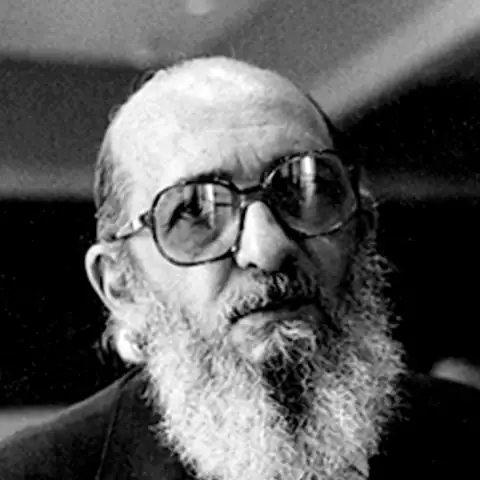
Portrait: Paulo Freire 1977.jpg by Slobodan Dimitro, CC BY-SA 3.0, via Wikimedia Commons. Cropped and converted to grayscale by 12axes-test.com.