12axes-testTake the test
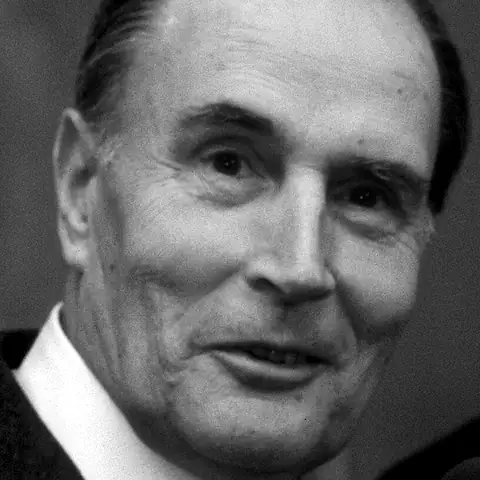
François Mitterrand
Historical figureFrance1916-1996

François Mitterrand

President of France (1981-1995) · First Secretary of the Socialist Party (1971-1981)

A French Socialist leader who won the presidency in 1981 as the Fifth Republic's first left-wing head of state, ended the death penalty and served 14 years.

Profile on 12 axes11 of 12 documented
ECONOMYSTATESOCIETYWORLDOwnershipMarketsWelfareAuthoritySecurityStructureMoralityReligionTechnologyCultureTradeForeign
Where they stood

François Mitterrand, axis by axis

  1. PublicPrivate

    He nationalized major companies in 1981-1982. After the 1983 austerity turn he stopped nationalizing and accepted more market opening.

  2. PlannedFree
  3. SharedSelf-reliant
  4. DemocraticStrong leader

    He had once criticized the Fifth Republic for giving the president too much power, but he used those powers fully for 14 years. The score leans only mildly toward democratic checks.

  5. LibertyOrder
  6. LocalCentral

    His governments passed the Defferre laws, which moved powers to local and regional bodies.

  7. ProgressiveTraditional
  8. SecularReligious
  9. 09TechnologyNo clear record
    EmbraceCaution

    There is no clear stance on technology, so this is left blank.

  10. MulticulturalNational identity
  11. GlobalProtected
  12. CooperationStrength

    He strongly backed European integration. He also kept France's own nuclear deterrent and ordered the 1985 Rainbow Warrior bombing.

One axis has no clear record, so matching leaves it out.

Who was François Mitterrand?

François Mitterrand was born in 1916. He was wounded and captured in 1940, escaped the next year, and joined the Resistance in 1943. From 1946 he sat in parliament and held several ministries before 1958, among them Interior and Justice. He then opposed Charles de Gaulle's return to power. In 1965 he forced de Gaulle into a second round, and in 1971 he took over and rebuilt the Socialist Party. He lost narrowly to Valéry Giscard d'Estaing in 1974 but won in 1981 and again in 1988. He left office in 1995, having twice governed alongside right-wing prime ministers. He died in January 1996.

Political views

  • His first months in power brought nationalizations, a 39-hour week, a fifth week of paid holiday and a big rise in the minimum wage.Source: en.wikipedia.org
  • In March 1983 he switched to austerity and made the fight against inflation the top aim.Source: elysee.fr
  • His government brought in a wealth tax and set the retirement age at 60.Source: en.wikipedia.org
  • The death penalty was abolished in 1981 under his presidency, and the Criminal Code was brought up to date.Source: en.wikipedia.org
  • Decentralization gave more freedom to local and regional authorities, and his government also widened freedom of expression.Source: elysee.fr
  • He supported the Maastricht Treaty, which passed the 1992 referendum with a little over 51 percent.Source: en.wikipedia.org
  • The UN Secretary-General described him as a strong defender of the United Nations and of its humanitarian missions.Source: press.un.org

Legacy

Supporters say Mitterrand brought the left to power after 23 years out of it, ended the death penalty, spread power to the regions and worked with Helmut Kohl to move Europe toward the euro. Critics on the left call the 1983 turn to austerity a betrayal. The right blames his first measures for inflation and three devaluations of the franc. His past also drew heavy scrutiny. He took the Vichy regime's Francisque medal in 1943, stayed friends with the ex-Vichy police chief René Bousquet, and as Justice Minister in the Algerian War had a part in 45 executions. His years in office also saw the 1985 Rainbow Warrior bombing, and a 2021 report commissioned by the French state found France bore heavy responsibility for backing the Rwandan government before the 1994 genocide.

How close are you to François Mitterrand?

Take the 12 Axes test and see which historical figure is your political twin, axis by axis.

Take the test

François Mitterrand: questions

Was François Mitterrand left or right?

He was on the left. He led the Socialist Party, rebuilt it in 1971, and became president in 1981 on a program of nationalization and social reform. After 1983 he governed in a more moderate, market-friendly way.

Was Mitterrand a socialist?

Yes, he was the Socialist Party's leader and its candidate for president. His early program was strongly socialist, but he turned to austerity in 1983 and later accepted much of the market economy.

Who ended the death penalty in France?

France abolished it in 1981, early in Mitterrand's first term. He had campaigned against it, and the law passed soon after he took office.

Sources

Portrait: President François Mitterrand in 1983.jpg by Comet Photo AG (Zürich), CC BY-SA 4.0, via Wikimedia Commons. Cropped and converted to grayscale by 12axes-test.com.