12axes-testTake the test
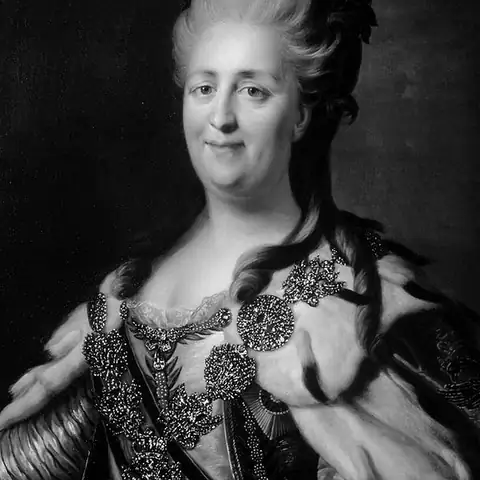
Catherine the Great
Historical figureRussia1729-1796

Catherine the Great

Empress of Russia (1762-1796) · Patron of the Hermitage

Russian empress who ruled 1762-1796, expanded the empire to the Black Sea and across Poland, spoke the language of the Enlightenment, and strengthened serfdom and noble privilege.

Profile on 12 axes9 of 12 documented
ECONOMYSTATESOCIETYWORLDOwnershipMarketsWelfareAuthoritySecurityStructureMoralityReligionTechnologyCultureTradeForeign
Where they stood

Catherine the Great, axis by axis

  1. PublicPrivate

    She secularized church estates and strengthened noble land and serf ownership, so the score leans toward private holdings under the nobility. It is a judgment.

  2. PlannedFree

    She allowed grain exports and backed the Free Economic Society, but the economy rested on serfdom.

  3. SharedSelf-reliant

    She set up public health administration and made smallpox inoculation free, but she tied serfs more firmly to their lords.

  4. DemocraticStrong leader

    She claimed Enlightenment ideas yet ruled as an autocrat with censorship; she dissolved her Legislative Commission without reform.

  5. LibertyOrder
  6. LocalCentral
  7. 07MoralityNo clear record
    ProgressiveTraditional
  8. SecularReligious

    She secularized church estates and tolerated Muslims and Jews, within an Orthodox state.

  9. EmbraceCaution

    She was inoculated against smallpox in 1768 and made the procedure free to the public, an open stance on new medicine.

  10. 10CultureNo clear record
    MulticulturalNational identity
  11. 11TradeNo clear record
    GlobalProtected
  12. CooperationStrength

3 axes have no clear record, so matching leaves them out.

Who was Catherine the Great?

Catherine II was born a German princess, married the Russian heir Peter III in 1745, and became empress when Guards officers deposed him in July 1762. She called herself a philosopher on the throne and corresponded with Voltaire and Diderot. In 1767 she convened a commission to recodify the laws, guided by her Great Instruction, but it produced no reforms. Her reign ended with Russia larger by about 200,000 square miles, with Crimea annexed in 1783 and a share of Poland taken in the partitions. She founded the Hermitage and died on 16 November 1796.

Political views

  • She was crowned in October 1762, drew on Montesquieu and other Enlightenment writers for her 1767 Great Instruction, and favored administrative uniformity, education and religious tolerance.Source: encyclopedia.com
  • In 1764 she secularized church estates and allowed grain exports.Source: encyclopedia.com
  • She privately disliked serfdom but saw no easy way to end it.Source: encyclopedia.com
  • One account says she did more to tie the Russian serf to his land and lord than any ruler since Boris Godunov.Source: newworldencyclopedia.org
  • Her reign had wide censorship. After Radishchev criticized serfdom in 1790 she exiled him to Siberia, and Novikov was also exiled.Source: newworldencyclopedia.org
  • A 1773 edict allowed Muslims to build mosques, and the 1782 Charter of the Towns recognized Jews as equal to Orthodox townspeople.Source: worldhistory.org
  • Pugachev's rebellion of 1773-1775 promised freedom for serfs and ended with his execution in January 1775.Source: worldhistory.org
  • She backed the Targowica Confederation against Polish reform after 1791, and Russia took part in the partitions of Poland.Source: newworldencyclopedia.org

Legacy

Admirers credit Catherine with modernizing Russia's administration and education, building the Hermitage, and winning access to the Black Sea. Critics point out that her Enlightenment language sat beside harsher serfdom, censorship and the exile of writers who criticized it. Her armies crushed Pugachev's peasant rebellion in 1775, and she took a leading part in the partitions of Poland, which ended the Commonwealth as a state. Her reforms did not outlast her. Her son Paul reversed many of her policies after he took the throne in 1796.

How close are you to Catherine the Great?

Take the 12 Axes test and see which historical figure is your political twin, axis by axis.

Take the test

Catherine the Great: questions

Did Catherine the Great end serfdom?

No. She privately disliked it, but one account says she tied serfs more closely to their lords. She exiled Radishchev for criticizing it in 1790.

Was Catherine the Great an Enlightenment ruler?

She presented herself as one and wrote the Great Instruction using Montesquieu. But the commission ended without reforms, and her rule kept censorship and autocracy.

Sources