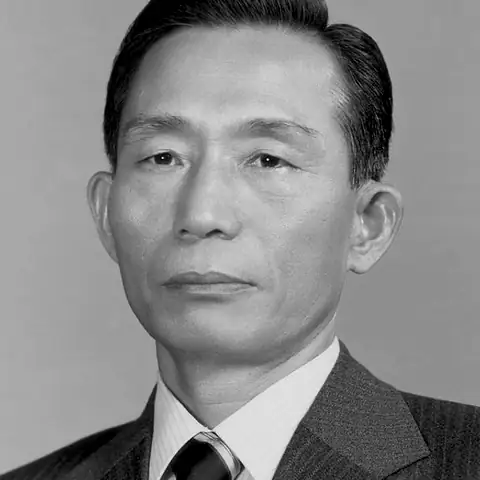
Who was Park Chung-hee?
Park Chung-hee, an army general, led the coup of 16 May 1961 and was elected president in 1963. He ran the country through five-year plans that steered cheap credit to exporting firms, and he launched the Saemaul rural movement in 1971. After a close election in 1971 he declared martial law in October 1972 and put through the Yushin constitution, which allowed him to serve indefinitely. He jailed opponents and relied on the intelligence service. Park was shot dead in October 1979 by the chief of that service.
Political views
- Led the coup of 16 May 1961, dissolved the National Assembly and set up a supreme council of officers, backed by a new intelligence agency, the KCIA.Source: countrystudies.us
- Pursued rapid export-based industrialization through five-year plans from 1962, giving exporting firms cheap loans, tax breaks and import privileges.Source: countrystudies.us
- Pushed steel, machinery, shipbuilding, electronics and chemicals in the third plan (1972-76) and launched the Saemaul movement in 1971 for village improvement.Source: countrystudies.us
- Declared martial law in October 1972, closed universities and imposed press censorship, then put through the Yushin constitution allowing him to serve indefinitely.Source: countrystudies.us
- Made criticism of the constitution a crime under Emergency Measure Number Nine in 1975, justifying it as national unity against North Korea.Source: countrystudies.us
- His intelligence agents abducted opposition leader Kim Dae Jung from a Tokyo hotel in 1973, and signers of a 1976 democracy declaration were jailed.Source: countrystudies.us
- Normalized relations with Japan in 1965 for loans and sent combat troops to Vietnam the same year.Source: countrystudies.us
Legacy
Admirers credit Park with lifting a poor, war-scarred country into an industrial power and with improving village life and farm incomes. Critics charge that he built his growth on a dictatorship. Under the Yushin system he shut down the legislature, censored the press, jailed students and opponents, and used the KCIA to abduct and detain dissidents. The 1971 shift to higher grain prices came after farm incomes had fallen behind. His late years brought inflation, recession and unrest that preceded his assassination. South Koreans still argue over whether the economic results justify the repression.