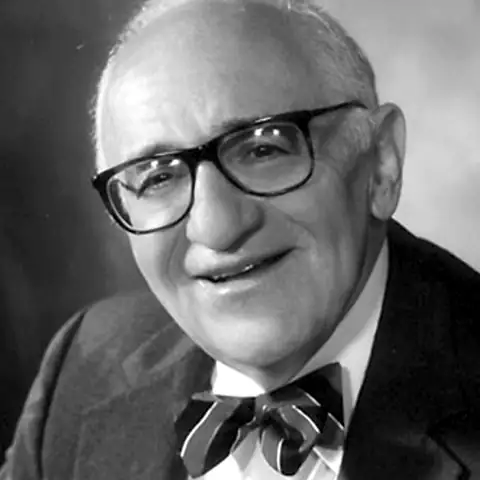
Who was Murray Rothbard?
A New Yorker by birth in 1926, Murray Rothbard studied at Columbia University, where his 1956 doctorate looked at the Panic of 1819. The book Human Action by Ludwig von Mises drew him to the Austrian school, and he attended Mises's seminar at NYU. He taught at Brooklyn Polytechnic, and later in Las Vegas at the University of Nevada. His major books include Man, Economy, and State, America's Great Depression, For a New Liberty and The Ethics of Liberty. He helped to found both the Cato Institute and the Mises Institute. He died in 1995.
Political views
- His political ethics began with self-ownership. From it he argued that a state's forced monopoly over protection can never be legitimate.Source: mises.org
- By 1949 he had concluded that if markets can supply goods and services, they can supply defence and protection too, with no coercive monopoly.Source: mises.org
- He wanted the state abolished, not just made smaller. He applied a nonaggression principle to taxes, the draft, war, welfare and regulation.Source: mises.org
- He attacked the Federal Reserve for expanding credit and blamed it for boom and bust. He favoured the gold standard with 100 percent reserve banking.Source: mises.org
- He said the 1929 crash and the Depression grew out of excess that the Federal Reserve created, and did not show that free markets had failed.Source: mises.org
- He opposed militarism and Cold War interventions, and he saw war as a main driver of bigger government.Source: mises.org
- On claiming unowned resources he took the most permissive view, with no limit on how much one person may appropriate.Source: mises.org
- He ran two small journals, Left and Right in the 1960s and The Libertarian Forum until 1984. In them he sought short-term alliances with any group that opposed militarism.Source: plato.stanford.edu
Legacy
Rothbard is widely seen as a founder of modern anarcho-capitalism, and his fans called him 'Mr. Libertarian'. The Stanford Encyclopedia of Philosophy names him the leading voice of American libertarianism while he lived. Supporters like the consistency of his case for liberty and peace, built on rights. Opponents doubt that a society without a state could protect those rights. Some also question the way his alliances moved from the New Left of the 1960s to the paleoconservatives of the 1990s.