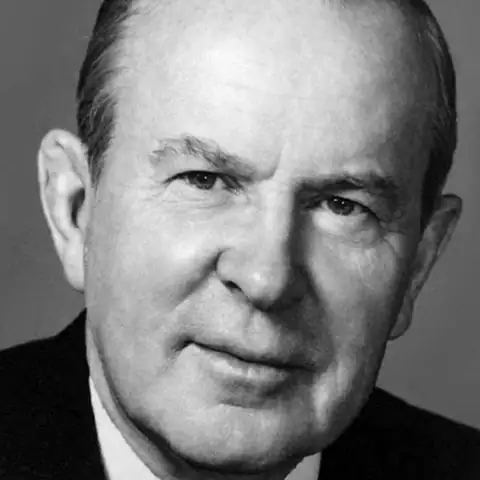
Who was Lester B. Pearson?
Pearson grew up as a Methodist minister's son in Ontario, where he was born in 1897. After army service in the First World War he taught history in Toronto and then moved into the foreign service. He rose to be Canada's ambassador in Washington, and in 1948 he came into Parliament as foreign minister. The Nobel committee honored him in 1957, and a year on the Liberals picked him to lead. He held the top job from 1963 until 1968, with two minority governments. Pearson died in 1972.
Political views
- During the 1956 Suez crisis he came up with a United Nations force to separate the fighting sides. This earned him the 1957 Nobel Peace Prize.Source: nobelprize.org
- Launched the Canada Pension Plan and student loans, and in 1966 passed medicare. Provinces that were wary were urged to accept equal access to publicly funded care.Source: biographi.ca
- Created a royal commission on bilingualism and biculturalism in 1963, because Quebec was the biggest domestic issue he faced.Source: biographi.ca
- Brought in a 1967 points system for would-be immigrants that weighed education, skills and language over nationality.Source: pier21.ca
- Asked in April 1965 for Washington to pause its bombing of North Vietnam. He also kept Canadian troops out of that war.Source: en.wikipedia.org
- Agreed the Auto Pact with the US in 1965.Source: en.wikipedia.org
- Gave Canada its Maple Leaf flag in 1965 after a long national argument.Source: en.wikipedia.org
Legacy
Many give Pearson credit for building, in just five years, a good part of modern Canada's social net and sense of itself: pensions, medicare, student loans, the flag and an immigration policy that ignored national origin. Abroad he is seen as a father of UN peacekeeping and a model for diplomacy by mid-sized powers. The foreign affairs headquarters in Ottawa is named after him. Critics note that his governments were fragile minorities, and that in January 1963 he accepted US nuclear warheads after having opposed them. The 1965 bombing-pause speech irked President Johnson, although most of the text backed American aims.