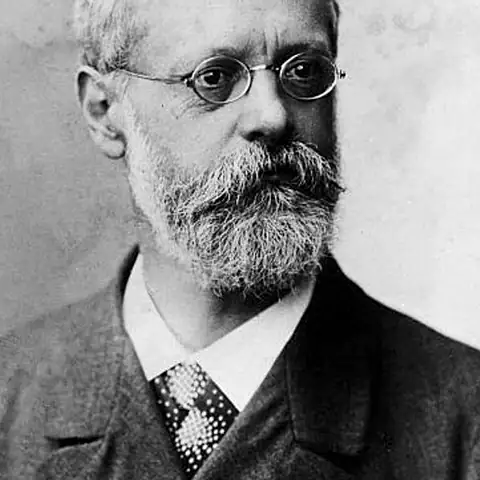
Who was Karl Kautsky?
Kautsky was born in Prague in 1854 and became the leading theorist of German Social Democracy. In 1891 he co-wrote the Erfurt Program with August Bebel and Eduard Bernstein. He edited the party journal Die Neue Zeit and defended Marxist orthodoxy against Bernstein. In 1914 he proposed that SPD deputies abstain on war credits, and in 1917 he left the party for the antiwar USPD. After the Russian Revolution he accused the Bolsheviks of dictatorship, and Lenin answered in 1918 with a pamphlet calling him a renegade. Kautsky rejoined the SPD in 1920 and died in Amsterdam in October 1938 after fleeing Austria.
Political views
- The 1891 Erfurt Program, which he co-wrote, was strongly Marxist and revolutionary in tone, yet encouraged members to work through existing political institutions.Source: newworldencyclopedia.org
- He denounced Bernstein's revisionism, arguing that stress on socialism's ethical basis opened the way to an alliance with the progressive bourgeoisie.Source: newworldencyclopedia.org
- In 1914 he suggested that SPD deputies abstain on war credits. In 1915 he joined Bernstein and Hugo Haase in an appeal against the party's pro-war leaders.Source: newworldencyclopedia.org
- He argued that democracy is essential to socialism, because the working class needs it to mature and to prove its maturity.Source: marxists.org
- He read the dictatorship of the proletariat as rule of a class on the basis of democracy, not a regime that disarms opponents by removing their vote, press and right to organize.Source: marxists.org
- He accused the Bolsheviks of dictatorship after they dissolved the Constituent Assembly and abolished universal suffrage.Source: newworldencyclopedia.org
- He held that nationalizing the means of production did not equal socialism, and saw Soviet Russia as a society where a new class ruled over the majority.Source: newworldencyclopedia.org
- He wrote that the path to power would differ by country, noting that Marx thought a peaceful route possible in England and America.Source: marxists.org
Legacy
Admirers see Kautsky as an early and clear defender of democratic socialism, who warned that Bolshevik rule would harden into one-party dictatorship. His Erfurt Program stayed the SPD's official program through the imperial period. Lenin attacked him as a renegade, and critics on the left said he had abandoned revolution. He opposed the war while the SPD's leaders backed it, and he left the party in 1917. Kautsky died in exile in 1938 after the Nazi annexation of Austria.