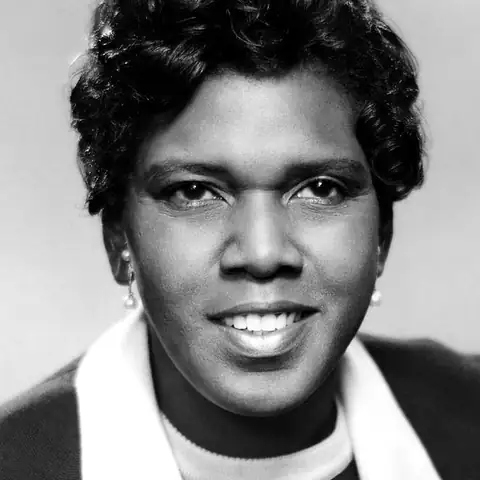
Who was Barbara Jordan?
Jordan was born in Houston in 1936, became, in 1959, the first African American graduate of Boston University Law School. After losing two races for the Texas House, she won a Texas Senate seat in 1966, the first Black woman elected to it, and in 1972 became president of the Senate. That year she also won election to the U.S. House of Representatives. As a member of the House Judiciary Committee she spoke in the Nixon impeachment hearings in 1974, and in 1976 she gave the Democratic National Convention keynote. She left Congress in 1979 to teach at the University of Texas, later led a federal immigration commission, and died in 1996.
Political views
- In the Texas Senate she supported the state's first minimum wage law, anti-discrimination language in business contracts and a Fair Employment Practices Commission.Source: womenshistory.org
- In 1972 she won election to the U.S. House, becoming the first African American woman from the South in Congress.Source: womenintexashistory.org
- She helped win an extension of the 1965 Voting Rights Act to cover Mexican Americans, and one account adds Native and Asian Americans.Source: womenintexashistory.org
- In the Nixon impeachment hearings in 1974 she said her faith in the Constitution was 'whole', 'complete' and 'total' and that she would not be an idle spectator to its destruction.Source: uh.edu
- In 1976 she was the first African American and the first woman to give the keynote speech at a Democratic National Convention.Source: womenshistory.org
- She spoke for the Democratic ticket of Kennedy and Johnson in 1960 and consulted President Lyndon B. Johnson on civil rights legislation.Source: biography.com
- President Clinton chose her in 1994 to lead the Commission on Immigration Reform.Source: womenintexashistory.org
Legacy
Admirers remember Jordan as one of the great American orators, a Texas and national figure who broke racial and gender barriers and who held up the Constitution as a standard for the powerful. She is also credited with civil rights and labor legislation in Texas and with extending the Voting Rights Act. She left politics in 1979 after a multiple sclerosis diagnosis, and some wonder what more she could have done.