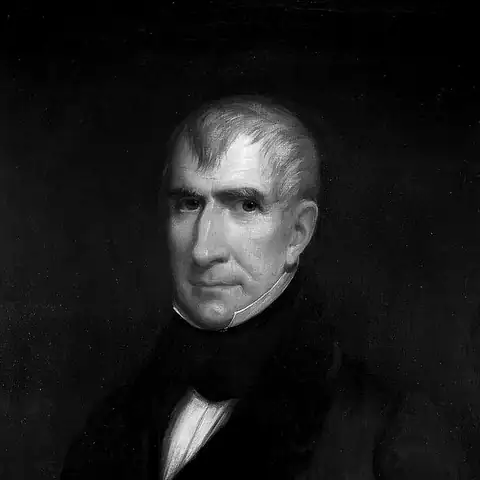
Who was William Henry Harrison?
William Henry Harrison was born in Virginia in 1773, the son of a man who signed the Declaration of Independence. He fought in the Northwest Indian War and in 1801 became governor of Indiana Territory. In that job he made treaties that moved huge areas of Native land into American hands. His troops clashed with Tecumseh's confederacy at Tippecanoe in 1811, and he won the Battle of the Thames in 1813. He later sat in Congress for Ohio. In 1840 he took the White House for the Whigs, in a "log cabin and hard cider" campaign that said little about policy. Illness struck soon after he took office. He died on 4 April 1841, the first president to die while serving.
Political views
- Promised in his inaugural address never to run again, and warned against the growth of presidential power.Source: millercenter.org
- Wanted the veto kept for defending the Constitution, the people or minorities, and not used to push Congress around on routine legislation.Source: millercenter.org
- Negotiated many treaties as Indiana's governor that took Native land for small payments, often after military defeats of the tribes.Source: millercenter.org
- Fought Tecumseh's followers at Tippecanoe in 1811, then defeated a combined British and Native army at the Thames in 1813.Source: millercenter.org
- Campaigned in 1840 as a rough frontier soldier and kept vague about the national bank and tariffs.Source: millercenter.org
Legacy
Harrison had no time to build a policy record. He is remembered for how short his term was and for what followed it. When he died, Vice President John Tyler took the full powers of the office, a precedent the 25th Amendment later made law. The 1840 race, with its songs, slogans and mass rallies, is often named the first modern presidential campaign. People of his day cheered him as a hero of the Old Northwest. Critics and many historians stress that his work as governor and general rested on taking Native land, in treaties often signed by men who could not speak for the nations concerned. They add that, despite living in the West, he steadily opposed any move by Congress to limit slavery's spread.