12axes-testTake the test
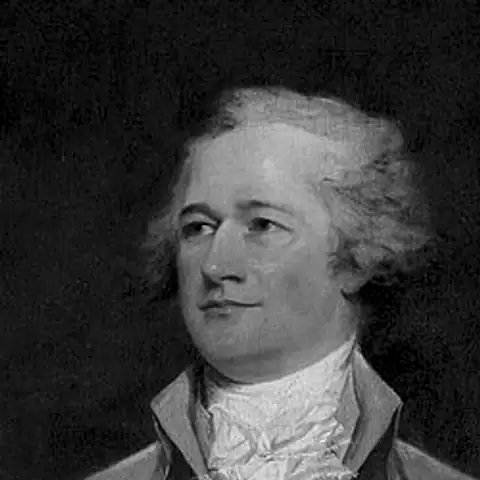
Alexander Hamilton
Historical figureUnited States1755-1804

Alexander Hamilton

1st U.S. Secretary of the Treasury · Co-author of The Federalist Papers

Founding Father and first Treasury Secretary who wanted a strong national government, a powerful president, a national bank and federal help for industry.

Profile on 12 axes11 of 12 documented
ECONOMYSTATESOCIETYWORLDOwnershipMarketsWelfareAuthoritySecurityStructureMoralityReligionTechnologyCultureTradeForeign
Where they stood

Alexander Hamilton, axis by axis

  1. PublicPrivate
  2. PlannedFree

    Friendly to trade and finance, yet he also wanted the state to steer industry through a bank, bounties and tariffs, so he sits near the centre.

  3. SharedSelf-reliant
  4. DemocraticStrong leader

    At the 1787 Convention he floated a lifetime executive, but he later defended the more limited Constitution that was actually adopted.

  5. LibertyOrder
  6. LocalCentral
  7. ProgressiveTraditional
  8. SecularReligious
  9. EmbraceCaution

    Leans toward embracing technology because his Report on Manufactures welcomed machinery and factories. He had no view on modern technology.

  10. 10CultureNo clear record
    MulticulturalNational identity

    No clear, steady position is recorded, so this axis is left blank.

  11. GlobalProtected
  12. CooperationStrength

One axis has no clear record, so matching leaves it out.

Who was Alexander Hamilton?

Alexander Hamilton was an immigrant from the Caribbean who rose from poverty to become one of the architects of the American state. He served on George Washington's staff in the Revolution, then pushed for a stronger union at the 1787 Constitutional Convention in Philadelphia. With James Madison and John Jay he wrote essays urging New Yorkers to accept the new Constitution. As Washington's Treasury Secretary he set up the country's public finances and led the Federalist Party. Historians disagree on whether he was born in 1755 or 1757. He was fatally shot in 1804 in a duel with Aaron Burr.

Political views

  • Wrote in The Federalist that a vigorous, single executive is necessary if a government is to work well.Source: avalon.law.yale.edu
  • At the Constitutional Convention he suggested a president and senators who would hold office for life, as long as they behaved well.Source: avalon.law.yale.edu
  • Wanted the national government to pay off the war debt in full and to take over the debts of the states.Source: millercenter.org
  • Planned the First Bank of the United States and a tax system built on customs duties and excise taxes.Source: home.treasury.gov
  • Suggested modest tariffs and cash bounties to help new American factories.Source: en.wikipedia.org
  • Favored strong national power, partly because he had seen a weak Congress struggle to supply the army during the war.Source: battlefields.org

Legacy

Supporters say Hamilton gave the young republic a sound financial base, with public credit, a bank and a revenue service, and that he saw early that America could become an industrial power. His writings are still studied, and the hit 2015 musical brought him back into public view. Opponents, led by Jefferson and Madison, said his plans enriched speculators and city merchants while farmers paid, and that they gave the federal government too much power. His life-term idea made some call him a secret monarchist. His record on slavery is debated: he belonged to an anti-slavery society, yet historians have found that he also handled purchases of enslaved people for relatives.

In their own words

“Energy in the Executive is a leading character in the definition of good government.”
The Federalist No. 70, 1788

How close are you to Alexander Hamilton?

Take the 12 Axes test and see which historical figure is your political twin, axis by axis.

Take the test

Alexander Hamilton: questions

Was Alexander Hamilton a Federalist?

Yes. He was the main leader of the Federalist Party. The party backed a strong national government, sound public credit and good trade ties with Britain.

Did Alexander Hamilton want a king?

No, but his critics said so. He proposed a president who could serve for life, and that idea made rivals suspect he liked monarchy. He later supported the Constitution as it was written.

What did Alexander Hamilton think about tariffs?

He backed moderate tariffs. They raised money for the government and, together with bounties, helped young American industries. He laid this out in his 1791 Report on Manufactures.

Sources